If you’ve spent any time around a tailgate, a hockey arena, or a college house party in the last few years, odds are someone has shoved a chilled shot of Pink Whitney into your hand and told you it’s “not a big deal.” It is, of course, kind of a big deal. What started as an offhand comment on a hockey podcast has grown into one of the most recognizable flavored vodkas in North America, and the story behind it is honestly more entertaining than most marketing case studies you’ll read this year. Let’s get into everything worth knowing about this pink bottle that refuses to stay on the shelf.
What Exactly Is Pink Whitney?
Pink Whitney is a pink lemonade-flavored vodka made by New Amsterdam Spirits, and it sits at 30% ABV, which works out to 60 proof. That’s a touch lower than a standard 80-proof vodka, and that small difference is part of why it goes down so smoothly. At its core, it’s New Amsterdam’s award-winning base vodka infused with bright, tart pink lemonade flavor, designed to taste less like a punishing liquor shot and more like the kind of drink you actually want a second round of. It’s not trying to be a sipping spirit you analyze for tasting notes; it’s built for fun, for crowds, and for nights that are meant to be loud. In a category absolutely flooded with gimmicky flavored vodkas that taste like cough syrup, Pink Whitney managed to land somewhere genuinely drinkable, and that’s a big reason it stuck around long after the hype should have faded.
The Origin Story: How a Podcast Joke Became a Bottle
This is where Pink Whitney gets fun, because it wasn’t dreamed up in a boardroom. Back in October 2018, former NHL player Ryan Whitney mentioned on an episode of the Spittin’ Chiclets podcast that his go-to way to drink New Amsterdam Vodka was simply mixing it with pink lemonade. That was it. No campaign, no slogan, just a guy talking about the drink he liked. The reaction from listeners was immediate and a little unhinged. Fans started making the combo at home, posting photos of their glasses, tagging the podcast, and organically coining the name “Pink Whitney” themselves. The demand built to the point where bars and even some NHL arenas began serving it as a specialty drink. New Amsterdam, which already sponsored the podcast, saw what was happening and made the smart move: instead of fighting the trend, they bottled it. The official Pink Whitney launched in September 2019, roughly a year after that casual podcast moment, making it New Amsterdam’s first flavor born directly out of fan enthusiasm rather than a corporate flavor lab. It’s one of those rare cases where the internet basically did the product development for free.
Who Is Ryan Whitney (and Why Does the Bottle Have His Name)?
If you’re not a hockey person, the name on the label might not mean much, so here’s the quick rundown. Ryan Whitney is a former NHL defenseman who played for several teams, including the Pittsburgh Penguins and the Edmonton Oilers, before retiring and reinventing himself as a media personality. After hanging up his skates, he became a co-host of Spittin’ Chiclets, the wildly popular hockey podcast under the Barstool Sports umbrella. The show blends locker-room storytelling, player interviews, and the kind of unfiltered humor that makes hockey fans feel like they’re hanging out with the guys. Whitney’s easygoing, “what a legend” personality is basically baked into the brand, and his name on the bottle isn’t just a celebrity slap-on. The drink genuinely was his thing first. His co-host Paul “Biz” Bissonnette, another ex-NHL enforcer with a massive following, is tied to the brand too, and the two of them together gave Pink Whitney an authenticity that most celebrity-backed spirits desperately wish they had. When the founder of a drink is also the person who actually drank it on a podcast, the marketing kind of writes itself.
What Does Pink Whitney Actually Taste Like?
Let’s talk flavor, because this is what keeps people coming back. Pink Whitney leads with that classic pink lemonade profile: sweet up front, with a zesty, tart citrus snap that keeps it from getting cloying. The balance between sweet and sour is the whole point, and it’s handled better than you’d expect from a vodka built on viral momentum. Taken as a chilled shot, it’s smooth and almost dangerously easy, with the lower 60-proof strength meaning you don’t get that harsh alcohol burn at the back of your throat. There’s a candy-like quality to it, sure, but it stops short of tasting artificial or syrupy, which is the trap so many flavored vodkas fall into. Some people find it a little on the sweeter side, and that’s a fair critique depending on your palate, but mixed with soda or served over ice, that sweetness mellows out into something refreshing rather than heavy. It’s the kind of flavor that’s approachable for people who normally don’t love straight liquor, which has a lot to do with how wide its fan base has spread.
The ABV and What That Means for Your Glass
That 30% ABV figure is worth dwelling on for a second, because it shapes the entire drinking experience. Standard vodka clocks in at 40% ABV, or 80 proof, so Pink Whitney is meaningfully lighter at 60 proof. On one hand, that lower strength is exactly why it tastes so smooth and why a chilled shot doesn’t feel like a chore. On the other hand, it’s a reminder to pace yourself, because “smooth and sweet” is precisely the combination that makes people forget they’re drinking actual liquor. The flavoring masks the alcohol effectively, which is great for taste and a little sneaky for sobriety. If you’re mixing it into cocktails, the lower proof also means the lemonade character comes through more cleanly without a heavy ethanol bite competing with it. Bottom line: treat it with the same respect you’d give any spirit, even though it tastes like something you could pour over breakfast pancakes.
How to Drink Pink Whitney (Beyond the Chilled Shot)
The chilled shot is the signature move, the thing the Spittin’ Chiclets crowd made famous, and honestly it’s the purest way to experience what the drink is about. But limiting yourself to shots is leaving a lot of fun on the table. The brand itself recommends a handful of easy serves, and they all hold up. Pour it over ice for a slow, refreshing sipper. Top it with club soda for a lighter, fizzy version that cuts the sweetness and stretches the bottle further. Mix it with lemon-lime soda like Sprite or 7UP for something brighter and bubblier that goes down like adult lemonade. Each of these takes about ten seconds to make and requires zero bartending skill, which is very much by design. This is a drink built for backyards and pre-games, not for someone fussing over a jigger and a cocktail shaker. The beauty of Pink Whitney is that the “recipe” is mostly just “add ice, maybe add bubbles, enjoy.”
Pink Whitney Cocktails Worth Trying
If you want to get a little more creative, Pink Whitney plays surprisingly well in actual cocktails. A Pink Whitney lemonade is the obvious starting point: a couple ounces of Pink Whitney, a splash of extra lemonade, plenty of ice, and a lemon wheel for looks. From there you can build out. Try it with cranberry juice and a squeeze of lime for a tarter, slightly more grown-up drink. Mix it with prosecco or any dry sparkling wine for a pink, celebratory spritz that’s perfect for parties and brunches that go off the rails. It also works beautifully in a slushy or frozen format; just blend it with ice and a bit of frozen lemonade concentrate for a boozy summer treat. For something punchy at a gathering, combine it with sparkling water, a handful of fresh berries, and a sprig of mint in a big pitcher. Because the flavor is so straightforwardly lemonade-forward, it acts almost like a pre-flavored base, doing half the work for you. You’re not trying to balance complicated bitter or herbal notes; you’re just amplifying what’s already there.
Where to Buy It and How Much It Costs
One of the most refreshing things about Pink Whitney, beyond the taste, is the price. This is not a spirit that asks you to take out a loan. A 750ml bottle typically runs somewhere in the neighborhood of $13, give or take depending on your state and retailer, which makes it an easy grab for stocking a party or just keeping a bottle around. It comes in a range of sizes too, from smaller bottles all the way up to the 1.75L handle for when you’re clearly planning ahead. Availability is broad across the United States, with the brand distributed in 40-plus states, so finding it at a local liquor store, a big-box retailer, or an online spirits shop is usually no trouble. The brand’s own website even has a store locator to help you track down the nearest bottle. For the combination of price, accessibility, and crowd-pleasing flavor, it’s hard to find a better value play in the flavored vodka aisle, which is a big part of why it became a staple rather than a one-season fad.
The Branding That Made It Pop
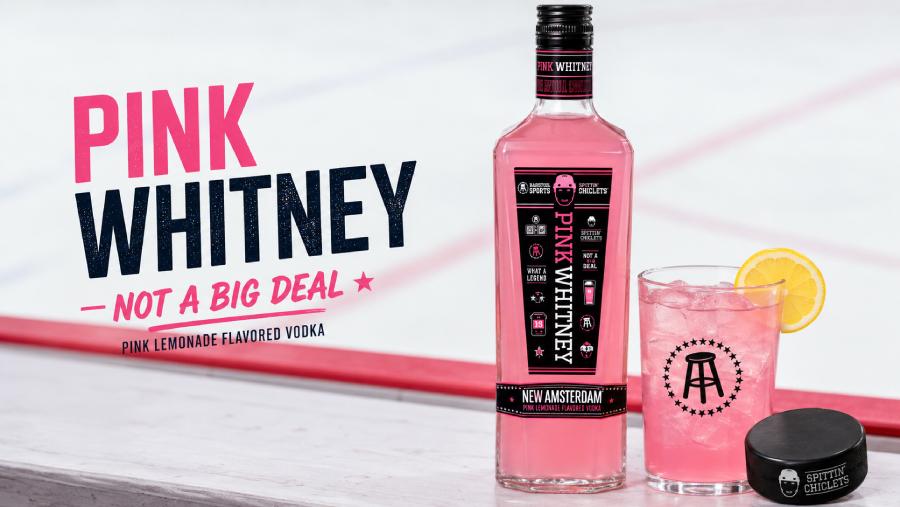
You can’t talk about Pink Whitney without acknowledging that the packaging and branding are doing serious heavy lifting. The bottle is loud and unmistakable, leaning hard into hockey culture and the Barstool ecosystem rather than trying to look like a premium European import. It carries the Barstool Sports and Spittin’ Chiclets logos, Ryan Whitney’s old NHL jersey number, and his signature catchphrase “What a Legend.” That’s not subtle, and it’s not supposed to be. Every design choice signals exactly who this drink is for: hockey fans, podcast listeners, and people who are in on the joke. New Amsterdam and Barstool leaned into that identity instead of softening it, promoting the launch heavily across their own platforms with social content, digital ads, and spots featuring Whitney and Bissonnette that aired around the start of hockey season. It was a masterclass in knowing your audience and speaking directly to them, no translation needed. The bottle doesn’t just hold the vodka; it broadcasts a whole subculture.
Why Pink Whitney Caught On When So Many Flavored Vodkas Flop
Here’s the part that fascinates me as someone who watches the spirits world. The flavored vodka graveyard is enormous. Brands roll out whipped cream, birthday cake, cotton candy, and a dozen fruit flavors every year, and most of them vanish quietly because they feel like cynical cash grabs. Pink Whitney went the opposite direction, and that’s the whole lesson. It was demanded into existence by fans before the company ever bottled it, which meant there was a real, organic audience waiting on day one rather than a product hunting for a market. The flavor was genuinely good and genuinely affordable, removing the two biggest reasons people don’t repurchase. And the cultural attachment, the connection to a podcast people love and personalities they trust, gave it staying power that pure flavor never could. It wasn’t sold as a novelty; it was sold as belonging to a community. That combination of authentic origin, solid product, and tight community alignment is incredibly rare, and it’s why Pink Whitney didn’t just trend and die. It became a tradition, especially around hockey season, which is exactly what the brand set out to be.
FAQs
Is Pink Whitney actually vodka or is it a liqueur?
It’s vodka, specifically New Amsterdam’s base vodka infused with pink lemonade flavor. The reason people sometimes mistake it for a liqueur is that it’s sweeter and lower in proof than a standard spirit, sitting at 30% ABV rather than the usual 40%. But it’s still classified and sold as a flavored vodka, not a liqueur.
How strong is Pink Whitney compared to regular vodka?
Pink Whitney is 60 proof, while most standard vodkas are 80 proof. That makes it noticeably lighter and smoother, which is why a chilled shot doesn’t burn the way regular vodka can. Just keep in mind that the sweet flavor hides the alcohol well, so it’s easier to overdo than you might expect.
What’s the best way to drink Pink Whitney for a first-timer?
For your first try, take it as a chilled shot straight from the freezer, since that’s the way it became famous and the purest taste of the product. If shots aren’t your thing, pour it over ice and top it with club soda or lemon-lime soda. Both serves are easy, refreshing, and show off the lemonade flavor.
How much does a bottle of Pink Whitney cost?
A standard 750ml bottle usually costs around $13, though the exact price varies by state and retailer. Larger sizes like the 1.75L handle cost more but offer better value per ounce. Overall, it’s one of the more budget-friendly flavored vodkas you’ll come across.
Who created Pink Whitney and where can I buy it?
It was created by New Amsterdam Spirits in partnership with Barstool Sports’ Spittin’ Chiclets podcast and former NHL player Ryan Whitney, whose favorite drink inspired it. You can find it at most liquor stores and many online spirits retailers across more than 40 U.S. states, and the brand’s website has a locator to find a bottle near you.
Conclusion
Pink Whitney is proof that the best products sometimes aren’t designed so much as discovered. A casual comment on a hockey podcast turned into a fan obsession, which turned into a bottle, which turned into a genuine staple of tailgates, arenas, and house parties across the country. It works because the flavor delivers, the price is friendly, the proof is approachable, and the whole thing is wrapped in a culture that people actually want to be part of. Whether you take it as a freezer-cold shot the way Ryan Whitney intended, stretch it over ice with some soda, or build it into a pitcher cocktail for a crowd, it does exactly what it promises: it’s easy, it’s fun, and it’s not a big deal. Which, of course, is what makes it such a big deal.