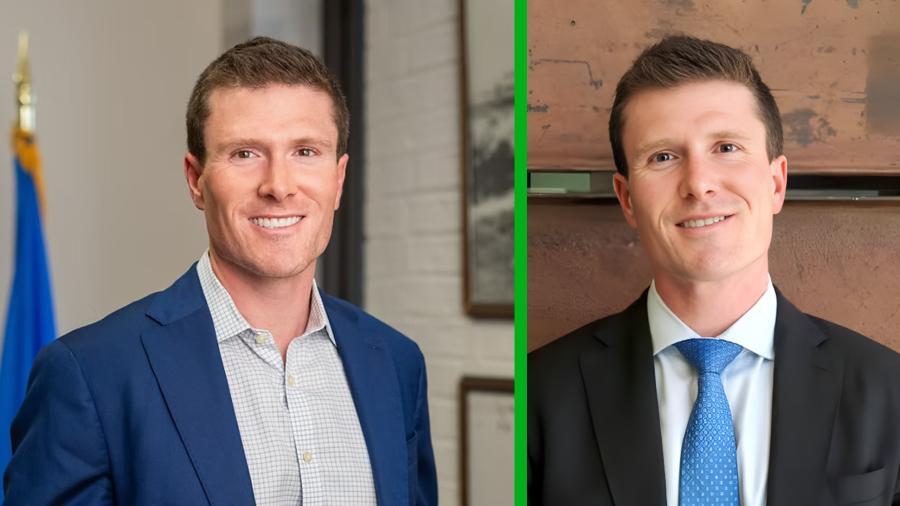
Nick Coffey is the kind of candidate who does not fit neatly into the usual political mold, and that is exactly what makes his story worth paying attention to. He is a former federal prosecutor who spent years in courtrooms going after cartel leaders, prison gangs, and drug traffickers, and now he wants to bring that same energy to the highest law enforcement office in Oklahoma. In a state that leans heavily Republican, Coffey is running as a Democrat, betting that voters care more about experience and integrity than party labels. Whether that bet pays off in November remains to be seen, but his rise from relatively unknown prosecutor to statewide nominee has already turned plenty of heads.
Who Is Nick Coffey?
Nick Coffey is a 34-year-old former Assistant U.S. Attorney from Oklahoma City who became the first Democrat to enter the 2026 race for Oklahoma attorney general. He launched his campaign in October 2025 after leaving the U.S. Attorney’s Office for the Western District of Oklahoma, and he has framed the entire effort around one central idea: rooting out corruption among elected officials. What sets him apart from a typical political hopeful is that he is not a career politician, and he says so openly. Instead, he built his name as a trial lawyer who took complex criminal cases all the way from investigation to verdict to sentencing. That prosecutorial background is the foundation of his pitch to voters, and it is the lens through which he wants people to understand his candidacy. He is, in his own words, a prosecutor first and a candidate second.
Early Life and Deep Oklahoma Roots
One of the things Coffey leans on most heavily is his identity as a fifth-generation Oklahoman, and the family geography backs that up. His mother’s side of the family comes from Tulsa, while his father’s side are ranchers from the northwestern part of the state. That mix of urban and rural roots gives him a claim to understanding Oklahoma from more than one angle, which is a useful thing to be able to say when you are trying to win votes across a state that is far from uniform. He grew up in the area and has spent most of his adult life in Oklahoma City, so this is not a candidate parachuting in from somewhere else. The “lifelong Oklahoman” framing is not just campaign decoration for him; it is genuinely woven into how he talks about himself and why he feels a sense of duty to serve the people of the state.
Education and the Path to Law
Coffey’s road into the legal profession ran straight through the University of Oklahoma, where he attended undergrad before graduating from the OU College of Law. While in law school he published a law review note, which is the sort of detail that signals he was a serious student rather than someone just coasting toward a diploma. Law review work tends to involve heavy research and careful writing, and it is often a marker of academic discipline. After earning his law degree, he did not jump straight into government work. Instead, he started his legal career at McAfee & Taft, one of Oklahoma’s well-known law firms, before making the move that would define his professional identity: joining the U.S. Attorney’s Office. That transition from private practice to federal prosecution is where his story really starts to gain momentum.
A Career as a Federal Prosecutor
For roughly seven years, Coffey worked as an Oklahoma City-based Assistant U.S. Attorney, and this is the experience he points to again and again on the campaign trail. During that stretch he handled a wide range of cases, including drug conspiracies, money laundering, illegal firearms offenses, immigration matters, and fraud. He did not just push paper or negotiate behind closed doors either; he regularly tried criminal cases in front of juries and argued appeals before the Tenth Circuit Court of Appeals in Denver. He worked hand in hand with agents from the DEA, the FBI, and Homeland Security, which means he was operating at the intersection of local and federal law enforcement on a daily basis. That kind of resume is uncommon among candidates for attorney general, and Coffey knows it. He has essentially built his campaign around a single pointed question to his opponents: have you ever actually tried a jury trial or worked alongside law enforcement the way I have?
The Cases That Built His Reputation
It is one thing to say you prosecuted criminals; it is another to be able to name the kinds of operations you took down. Coffey’s casework includes prosecuting black market marijuana operations, drug and firearm offenses, and members of the Irish Mob Gang, an Oklahoma-based prison gang. He has also described working on cases involving cartel extraditions, which is about as high-stakes as federal prosecution gets. These are not the sort of low-level matters that fill up a routine docket; they are the complex, multi-layered investigations that require coordination, patience, and a willingness to go after dangerous people. When he talks about getting a 3 a.m. phone call after a high-profile arrest and having to protect an investigation while moving against other members of a trafficking organization, he is describing the real texture of the job. That lived experience is the heart of his argument that he is uniquely prepared for the attorney general’s role.
Awards and Recognition Along the Way
Coffey’s work did not go unnoticed within the law enforcement community, and the recognition he earned adds weight to his prosecutorial credentials. In 2024, he was named Prosecutor of the Year by the U.S. Attorney’s Office for the Western District of Oklahoma, and he was reportedly the youngest person ever to receive that honor in the office’s history. A year earlier, in 2023, Homeland Security Investigations recognized him as Prosecutor of the Year for his role in dismantling a multi-state drug trafficking organization that operated between Oklahoma and Michigan. Awards like these matter in a campaign context because they are not self-bestowed; they come from the institutions and colleagues who watched him work. For a candidate trying to convince voters that his experience is the real deal, having that kind of third-party validation from within the federal prosecutorial world is a meaningful asset.
Why He Decided to Run for Attorney General
The motivation Coffey gives for entering the race is consistent and blunt: he believes corruption is running rampant through Oklahoma’s elected offices, and he wants to do something about it. He has said he left the Department of Justice specifically to run, framing his decision as a choice to keep self-interested politicians in check and to keep politics out of the attorney general’s office. He views the role as fundamentally nonpartisan, describing the job as one where you call out illegal and unethical behavior wherever you find it, regardless of who is involved. There is also a personal, almost democratic-with-a-lowercase-d angle to his pitch. He has emphasized that he does not come from wealth, does not have a trust fund, and has no family members who have held political appointments, presenting himself as proof that an ordinary person who simply worked hard can still run for high office. That outsider framing is central to his appeal.
The 2026 Campaign Launch
Coffey officially launched his campaign on October 14, 2025, and in doing so he became the first Democratic candidate to enter the 2026 attorney general race. The timing was notable because it came at a moment when the incumbent attorney general, Gentner Drummond, had decided to run for governor rather than seek reelection, leaving the office open. In his announcement, Coffey leaned into his prosecutorial track record, talking about taking down cartel leaders, violent prison gangs, and mafia bosses, and promising to bring that same level of accountability to keeping politicians honest. He pledged to protect Oklahoma families, defend constitutional freedoms, and deliver justice while going after the corruption and grifting he says is widespread among state officials. The launch was not just a quiet press release either; it included an endorsement from former NFL player and radio host Gabe Ikard, a childhood friend who grew up on the same street as Coffey and went to school with him from kindergarten through college.
Winning the Democratic Primary
The primary phase of Coffey’s campaign turned out to be the smoothest part of the journey, largely because no other Democrat stepped up to challenge him. When the Oklahoma primary was held on June 16, 2026, Coffey won the Democratic nomination in what was effectively an uncontested race. That outcome is significant for a couple of reasons. First, it reflects how rare a contested Democratic attorney general race has become in Oklahoma; there had not been a Democratic primary for the office since 1994, the year that eventually led to Drew Edmondson’s election. Second, it meant Coffey could conserve resources and avoid the bruising intraparty fights that sometimes weaken a nominee before the general election even begins. While his Republican rivals battled it out, Coffey was able to step into the fall campaign as a unified standard-bearer for his party, which is no small advantage heading into November.
The Road to the General Election
On the Republican side, the primary was a genuine contest, and the man who emerged is former state lawmaker Jon Echols. Echols defeated Jeff Starling, the state’s energy and environment secretary, taking around 55 percent of the vote to lock up the GOP nomination. Echols brings his own substantial resume to the table, having represented southwest Oklahoma City in the state House of Representatives from 2012 to 2024 and serving as House majority floor leader for the last eight years of that tenure. That sets up a fascinating general election contrast: Coffey, the career courtroom prosecutor with no prior political office, against Echols, the seasoned legislator with deep experience inside the state Capitol. The general election is scheduled for November 3, 2026, and it promises to be a real test of whether Coffey’s “experience over party” message can break through in a state where Republicans dominate statewide races.
What Nick Coffey Stands For
Beyond the broad anti-corruption theme, Coffey has laid out a platform that emphasizes practical priorities. He talks about consumer protection and accountability, and he wants to keep politics out of prosecutions, treating the attorney general’s office as a neutral enforcer of the law rather than a political weapon. He has called for action against prison-based drug networks, an issue he is intimately familiar with given his prosecution of prison gangs, and he has raised concerns about contraband cellphones fueling criminal activity behind bars. Interestingly, he does not believe the attorney general should swallow up every high-profile case. Instead, he argues the office should support local law enforcement and district attorneys with specialized expertise, coordinating on tough cases like narcotics trafficking rather than centralizing all power in the AG’s office. That is a relatively measured, prosecutor’s-eye view of how the office should function day to day.
The Personal Side of Nick Coffey
Away from the courtroom and the campaign trail, Coffey comes across as a fairly grounded person with hobbies that match his disciplined professional reputation. He is a long-distance runner and a four-time marathoner, which tells you something about his tolerance for long, grinding efforts. He also enjoys hiking and camping, and he is a conversational Spanish speaker, a skill that surely came in handy during his federal cases. On the family front, he describes himself as a dedicated uncle and godfather, and he has spoken warmly about being godfather to two young boys he cares deeply about. There is no public mention of a spouse or children of his own, and he has been candid about not coming from a politically connected or wealthy family. That combination of personal modesty and physical endurance fits the larger image he projects: someone who shows up, does the work, and keeps going.
The Bigger Picture: A Democrat in Deep-Red Oklahoma
It would be a mistake to talk about Coffey’s campaign without acknowledging the steep hill he faces. Oklahoma is one of the most reliably Republican states in the country, and Democrats have struggled to win statewide office there for years. The fact that the party did not even field an attorney general candidate in 2022, and that Coffey is the first Democrat to seek the office since 2018, underscores just how uphill this battle is. His strategy of downplaying party and emphasizing prosecutorial experience is a clever response to that reality, since it gives independent and even some Republican voters a reason to consider him without feeling like they are betraying their usual political instincts. Running on a platform of cleaning up corruption is also a well-worn path in Oklahoma politics, one that has historically resonated with voters frustrated by scandal. Still, message and momentum can only carry a candidate so far in a state with such a strong partisan lean.
Conclusion
Nick Coffey represents an unusual and compelling story in Oklahoma’s 2026 election cycle. He is a prosecutor who traded a stable federal career for the uncertainty of a statewide campaign, motivated by a genuine-sounding frustration with corruption and a belief that his courtroom experience is exactly what the attorney general’s office needs. He cleared the Democratic primary without opposition, he has a track record that few candidates can match, and he has built a message designed to reach beyond his own party. At the same time, he is running in a state where the political math is stacked against any Democrat, and his opponent is a battle-tested legislator who knows how to win. Whether Coffey’s experience-first approach can overcome Oklahoma’s partisan gravity will be one of the more interesting questions to watch as November approaches. Regardless of the outcome, his candidacy has already added a fresh and substantive voice to the conversation about what the state’s top law enforcement officer should actually do.